
Susquehanna County Arrest Records and Charges
Arrest records start on the law-enforcement side. They may involve the agency that made the arrest, the place where the person was held, the date of custody, bail handling, and transport. In Susquehanna County, the Sheriff's Office is tied closely to the court system because it executes arrest warrants, transports prisoners, serves court orders, and provides court security. That does not make the sheriff page a complete jail blotter, and the county research did not locate a standard public mugshot or booking database.
Court charge records start when the accusation enters the court track. The Clerk of Courts maintains criminal filings, bench warrants, bail bonds, dispositions, fines, costs, restitution, expungements, and related criminal matters. Magisterial District Courts handle many early steps, including preliminary arraignments and preliminary hearings. The Court of Common Pleas handles county-level criminal cases after charges move forward. For custody and housing questions, use the Susquehanna County inmate records route. For the full case file and sentence, use Susquehanna County criminal court records.
Susquehanna County Charges After Arrest
The most useful charge record is usually the docket entry, not a booking note. Pennsylvania UJS Case Search can be used to look for public criminal and Magisterial District Court docket information by participant name, docket number, OTN, complaint number, incident number, citation number, or other available search keys. In Susquehanna County, local criminal file questions can also route to the Clerk of Courts, while criminal-history background checks route to the State Police PATCH system rather than a docket screenshot.
The county police department directory identifies local and state law-enforcement contacts, including Pennsylvania State Police at Gibson, municipal police departments, county detectives, and the sheriff. These agencies may be part of the arrest or complaint path, but the charge that appears in court is read through the docket and the filed charging document.
The county police directory is one official source for agencies that may appear beside a Susquehanna County arrest or charge record: Susquehanna County police departments.
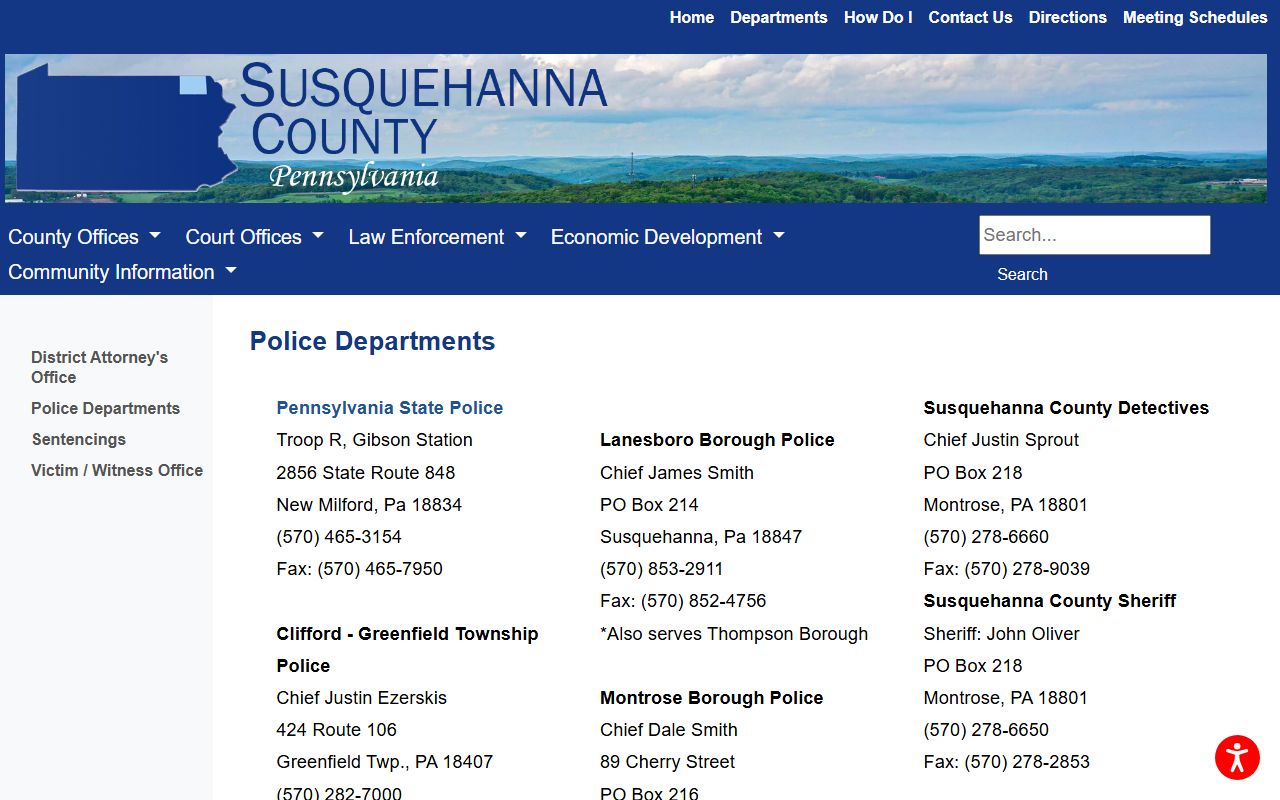
Use the agency name as a clue, then verify the charge and status through the court or criminal-history channel that fits the record.
- Search Pennsylvania UJS Case Search by participant name, docket number, OTN, complaint number, incident number, or citation number.
- Open the public docket and read the offense list, grading, court, case status, docket entries, and disposition fields that are shown.
- For local criminal file copies or older matters, contact the Susquehanna County Clerk of Courts at the courthouse address used for county court filings.
- For an official criminal-history check, use PATCH, the Pennsylvania State Police criminal history system.
Susquehanna County Charging Documents
Charges after arrest may begin in a criminal complaint or citation at the Magisterial District Court level and may later move to a formal information in the Court of Common Pleas. Pennsylvania practice does not make every local case an indictment case. The important point for a court charge search is to identify which document started or carried the offense and whether the listed count remained the same through later docket entries.
| Document | Where It Fits | What to Read |
|---|---|---|
| Complaint | Often starts a criminal or MDJ matter after police action. | Offense, complaint number, incident number, OTN, arresting or filing agency, and preliminary steps. |
| Information | Formal Common Pleas charging document filed by the prosecutor after a case moves forward. | Counts filed by the Commonwealth, grading, statute references, and any later amended counts. |
| Indictment | Not the routine local path for most county criminal docket review. | Use only when the docket or prosecutor record shows an indictment-based case. |
The District Attorney's Office is responsible for criminal complaints, PFA petitions, victim/witness services, and preparing and conducting criminal cases scheduled with the Court of Common Pleas. The office phone is 570-278-6655. County Detectives can be reached through 570-278-6659 and 570-278-6661. Victim/Witness services are handled at 570-278-6657.
Susquehanna County Charge Status
A charge record can change while a case is pending. One arrest may produce several counts, and each count can have a different path. A docket may show that a count was held for court, amended, reduced, dismissed, withdrawn, or resolved by plea or verdict. Read each count on its own instead of treating the first charge list as the final result.
| Status | Plain Meaning | Search Tip |
|---|---|---|
| Pending | The charge has not reached a final disposition. | Check future hearings, docket entries, and bail or warrant notes. |
| Amended or reduced | The offense wording, statute, or grading changed. | Compare the original complaint with later Common Pleas entries. |
| Dismissed or withdrawn | The count did not continue as filed. | Look for the specific count, not just the case-level outcome. |
| Nolle prosequi | The prosecutor chose not to pursue that count. | Confirm whether other counts in the same case continued. |
| Disposition entered | The court recorded a result for the charge. | Read the sentence, costs, restitution, and appeal entries if present. |
Susquehanna County Charge vs Conviction
Being charged is not the same as being convicted. A charge is an accusation filed into a public court process. A conviction follows a guilty plea, verdict, or other conviction-level outcome. This distinction matters for employment, licensing, housing, volunteer work, and personal record review because a docket may list accusations that did not result in conviction.
| Point | Charge | Conviction |
|---|---|---|
| Stage | Filed after arrest or citation. | Entered after plea, verdict, or qualifying resolution. |
| Meaning | An accusation by police or prosecutors. | A final finding or admission of guilt. |
| Where to check | UJS docket, complaint, information, Clerk of Courts file. | Disposition, sentencing entry, and PATCH where CHRIA allows dissemination. |
| Risk of misread | May look serious before it is resolved. | May apply to fewer counts than were first filed. |
For defense help, the Public Defender provides cost-free representation to eligible people in criminal matters from traffic offenses through homicide, from pre-arrest through appeal. Linda LaBarbera is listed as Public Defender, with office hours from 9 a.m. to 4:30 p.m. and phone 570-278-4600 ext. 6681.
The Public Defender page is an official county source for representation and application details tied to Susquehanna County arrest records and court charges: Susquehanna County Public Defender.
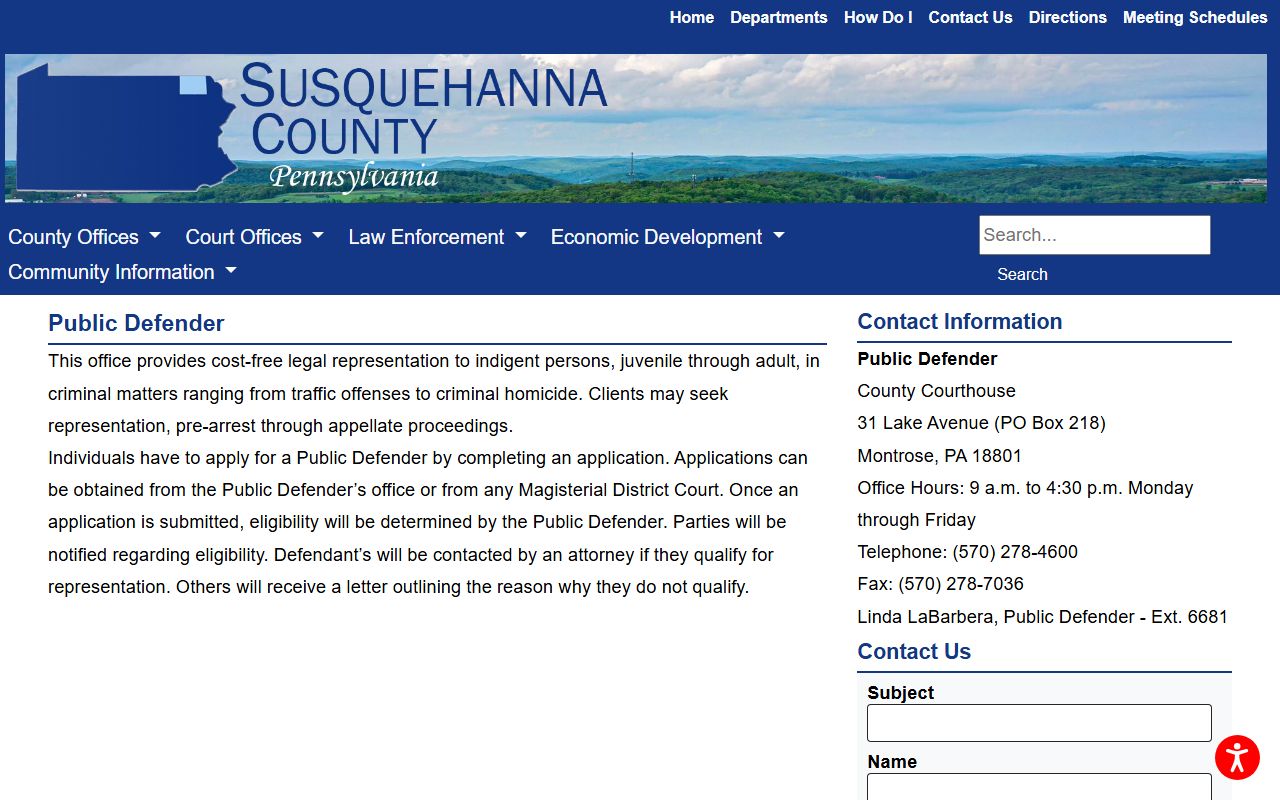
Representation status does not change public docket access, but it can affect how a person responds to pending charges.
Susquehanna County Charge Lookup Channels
Use the channel that matches the question. UJS is for public docket lookup. The Clerk of Courts is the local criminal-file custodian. PATCH is for Pennsylvania criminal-history checks under 18 Pa.C.S. Section 9121. The sheriff and Inmate Control routes are for warrants, transport, custody, and bail status, not for a complete criminal-history report.
| Need | Best Channel | Why It Matters |
|---|---|---|
| Public court charges | UJS Case Search | Shows public docket and charge activity for Common Pleas and MDJ cases. |
| Official local criminal file | Clerk of Courts | Handles criminal filings, bail, bench warrants, fines, restitution, appeals, and expungements. |
| Criminal-history background check | PATCH | State Police system for CHRIA criminal-history dissemination. |
| Arresting agency context | Police, sheriff, or county detectives | May explain the incident or agency tied to a complaint number. |
Victims and Charge Changes
Charge reductions, plea changes, bail events, detention, release, restitution, and victim impact statements may also involve the Victim/Witness Office. The county lists services such as requested notification of detention or release, accompaniment to proceedings, victim input before charge reductions or plea changes in personal injury and burglary cases, help with compensation claims, property return, and restitution information.
The official Victim/Witness Office page gives the county source for these services: Susquehanna County Victim/Witness Office.
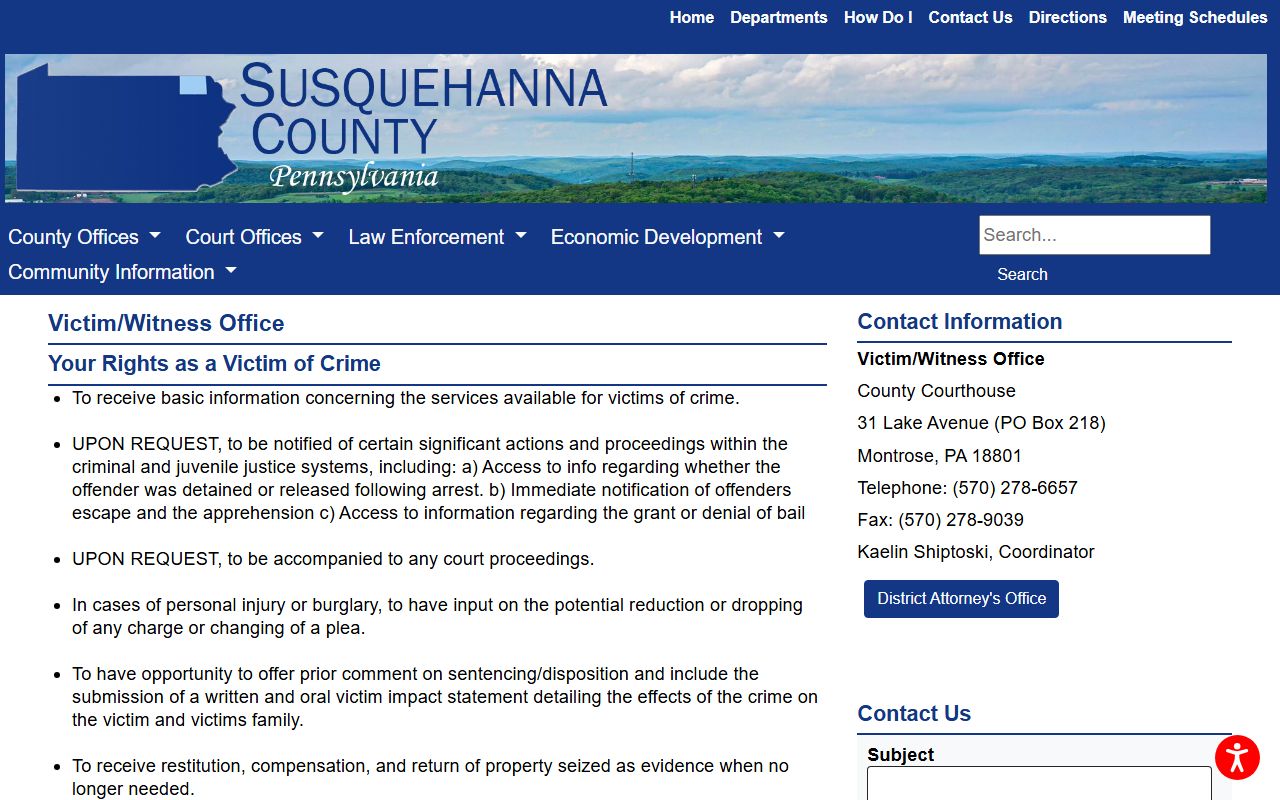
Victim notification is separate from public charge lookup, but it can be central when charges are reduced, dismissed, or resolved by plea.
Restricted Susquehanna County Charge Records
Not every arrest or charge record is fully public. Pennsylvania's Case Records Public Access Policy protects confidential case information and separates remote access from access that may be available through a records custodian. Juvenile records, sealed matters, expunged records, limited-access records, and some personal identifiers are restricted. Adoption files are sealed by local FAQ, and military discharge records are not open to the public.
| Record Type | Public Access Effect | Authority or Office |
|---|---|---|
| Expunged record | Removed or destroyed for public dissemination where the order applies. | 18 Pa.C.S. Section 9122 and Clerk of Courts processing. |
| Limited access | Restricts public access without treating every record as fully expunged. | 18 Pa.C.S. Sections 9122.1 and 9122.2. |
| Juvenile record | Handled under separate access limits. | 18 Pa.C.S. Section 9123 and court rules. |
| Confidential identifiers | Protected or redacted from public case access. | UJS public access policy. |
Important: A public docket is not a consumer report and should not be used as an FCRA background check.
Charge visibility can also change over time. A charge may appear when filed, then later be amended, withdrawn, dismissed, placed under limited access, or affected by an expungement order. The public docket may still show a case history while the formal criminal-history product treats the event differently. For that reason, Susquehanna County arrest records and court charges should be read with the date, disposition, and source in mind. When legal status matters, verify through the Clerk of Courts, the court order, or Pennsylvania State Police rather than relying only on a name search.