
Susquehanna County Probate Offices
The Register of Wills handles probate of estates, inheritance tax collection for the Pennsylvania Department of Revenue, and inheritance tax returns. The Clerk of Orphans' Court handles adoptions, guardianship appointments for minors or incapacitated persons, marriage licenses, and care of older county birth and death records from 1893 to 1905.
Both channels are tied to the courthouse at 31 Lake Avenue, PO Box 218, Montrose, PA 18801. The main county phone is 570-278-4600. Register and Recorder extensions are 4065, 4066, and 4067. Clerk of Orphans' Court extension 4067 and fax 570-278-2963 are listed with Wendy Zapolski. Hours are 8:30 a.m. to 4:30 p.m., and the office asks visitors to make an appointment for probate work.
Register of Wills
31 Lake Avenue, PO Box 218
Montrose, PA 18801
570-278-4600 ext. 4065/4066/4067
8:30 a.m.-4:30 p.m.
Clerk of Orphans' Court
31 Lake Avenue, PO Box 218
Montrose, PA 18801
570-278-4600 ext. 4067
Fax: 570-278-2963
Susquehanna County Probate Terms
Probate terms matter because the office may ask whether a person is opening an estate, seeking copies from an older file, filing inheritance tax, or starting an Orphans' Court matter. These short definitions keep the request focused.
- Testator
- A person who made a will before death.
- Executor
- The person named in a will to handle estate duties after appointment.
- Administrator
- The person who may qualify when there is no will or no executor can serve.
- Intestate
- A death without a valid will.
- Guardianship
- An Orphans' Court matter involving a minor or incapacitated person's care or estate.
Open Susquehanna County Estate Records
The county FAQ gives a practical estate-opening checklist. Call the Register of Wills for an appointment and fee estimate before appearing. The fee depends on the value of the estate, so the office needs enough information to estimate costs and prepare the appointment.
- Bring the original will, if the decedent had one.
- Bring the death certificate.
- Identify the person who can qualify as executor or administrator.
- Estimate the date-of-death value of real estate and personal property.
- Bring cash or check for probate fees, unless the office confirms another payment method applies.
After the estate is opened, the process may include appointment, notices, inventory or accounting work, inheritance-tax duties, creditor handling, and distribution. A contested will, guardianship, adoption, or incapacity issue moves into Orphans' Court filing territory rather than a simple counter transaction.
Search Susquehanna County Probate Records
No standalone county probate search portal was located in the official county pages. For public estate records, contact the Register of Wills or Register and Recorder office for in-person or mail copy access. Orphans' Court references may appear in Pennsylvania UJS Case Search, but that system is not a full replacement for local estate-file copies.
The Register of Wills source page is the county record access point for estate-related rules.
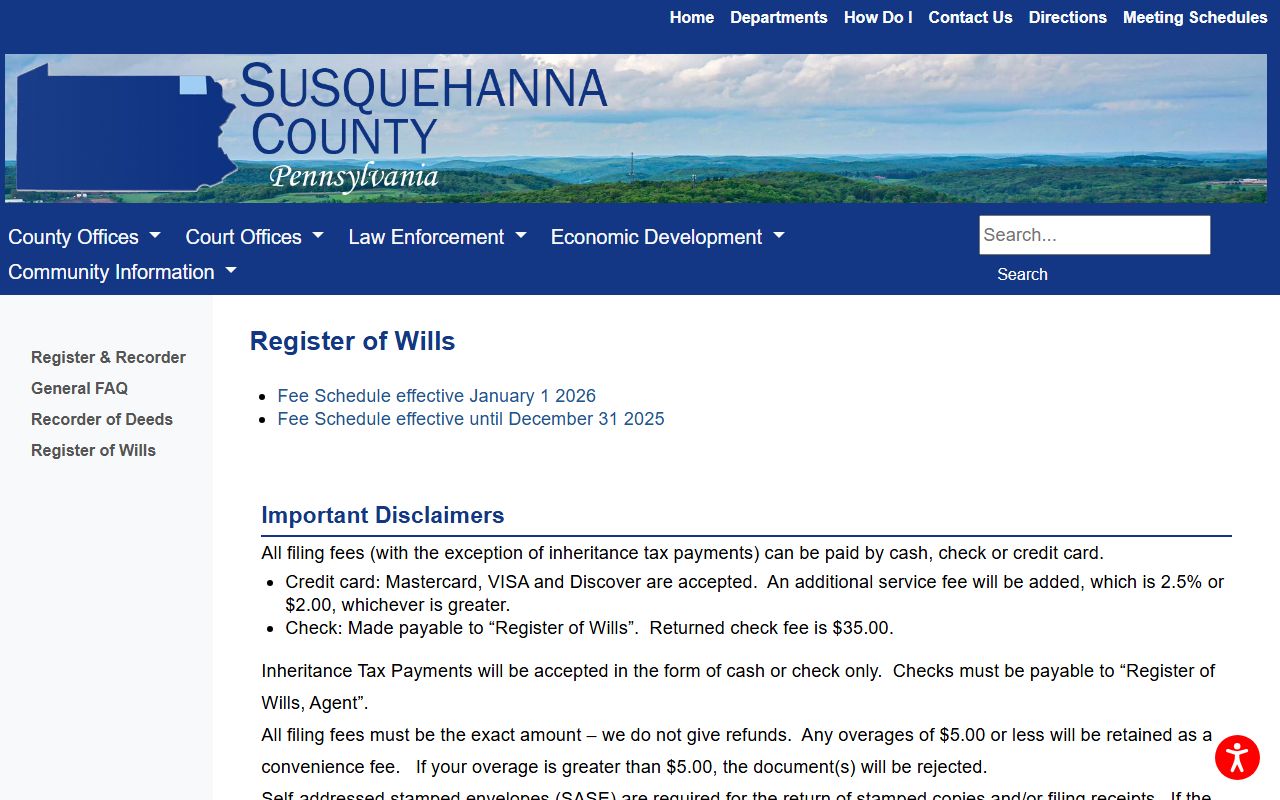
Use that office for estate appointment, payment, certified copy, and inheritance-tax filing questions.
Susquehanna County Probate Fees
Probate payments have strict rules. All Register of Wills filing fees except inheritance tax may be paid by cash, check, or credit card. Inheritance tax is cash or check only, and checks must be payable to "Register of Wills, Agent." Other Register of Wills checks are payable to "Register of Wills."
| Item | Rule or amount |
|---|---|
| Credit card service fee | 2.5% or $2, whichever is greater |
| Returned check | $35 |
| Office copies | $0.50 per page |
| Stamp certification | $1.50 |
| Postage without SASE | $1 for every 5 pages or fraction |
| Unlisted fee | Set by the Register of Wills |
Exact payment matters. The county says no refunds are issued, overages of $5 or less are retained as a convenience fee, and larger overages cause rejection. A self-addressed stamped envelope is required for stamped copies or filing receipts unless postage is paid under the county rule.
Certified Susquehanna County Estate Copies
Certified estate copies may be needed for banks, title work, transfer agents, or another court. The county allows public records in the Register and Recorder office to be requested in person or by mail, but the requester should contact the office for any fee not listed. Loose copy requests should identify the decedent, estate, file year if known, document type, number of copies, and return method.
The county also has a specific rule for certified or exemplified estate records from another county. If such records are submitted for filing, they must be bound in their original certified form with no sign of disturbance. Loose, disassembled, or rebound records will be rejected.
The county FAQ is a source for estate-opening, copy, and older-record boundaries.
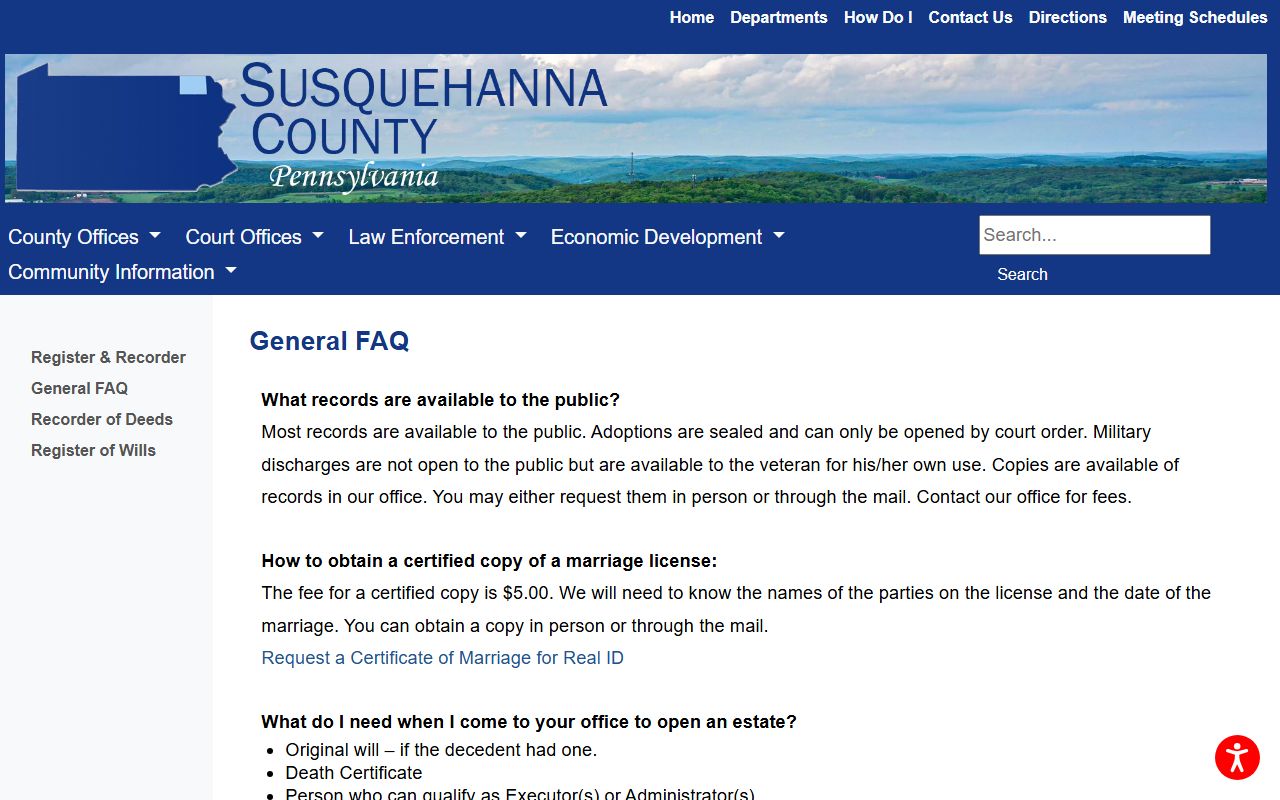
That FAQ helps separate public estate copy access from restricted Orphans' Court files and older vital records.
Restricted Susquehanna County Probate Records
Not every Orphans' Court or Register of Wills file is open in the same way. Adoption records are sealed and require a court order. Guardianship and incapacitated-person records may have access restrictions under Orphans' Court rules and Pennsylvania court public-access policy. Requesters should describe the needed record without assuming a clerk can release sealed material.
The Clerk of Orphans' Court page is the county source for adoptions, guardianships, marriage licenses, and the office's older birth and death records.
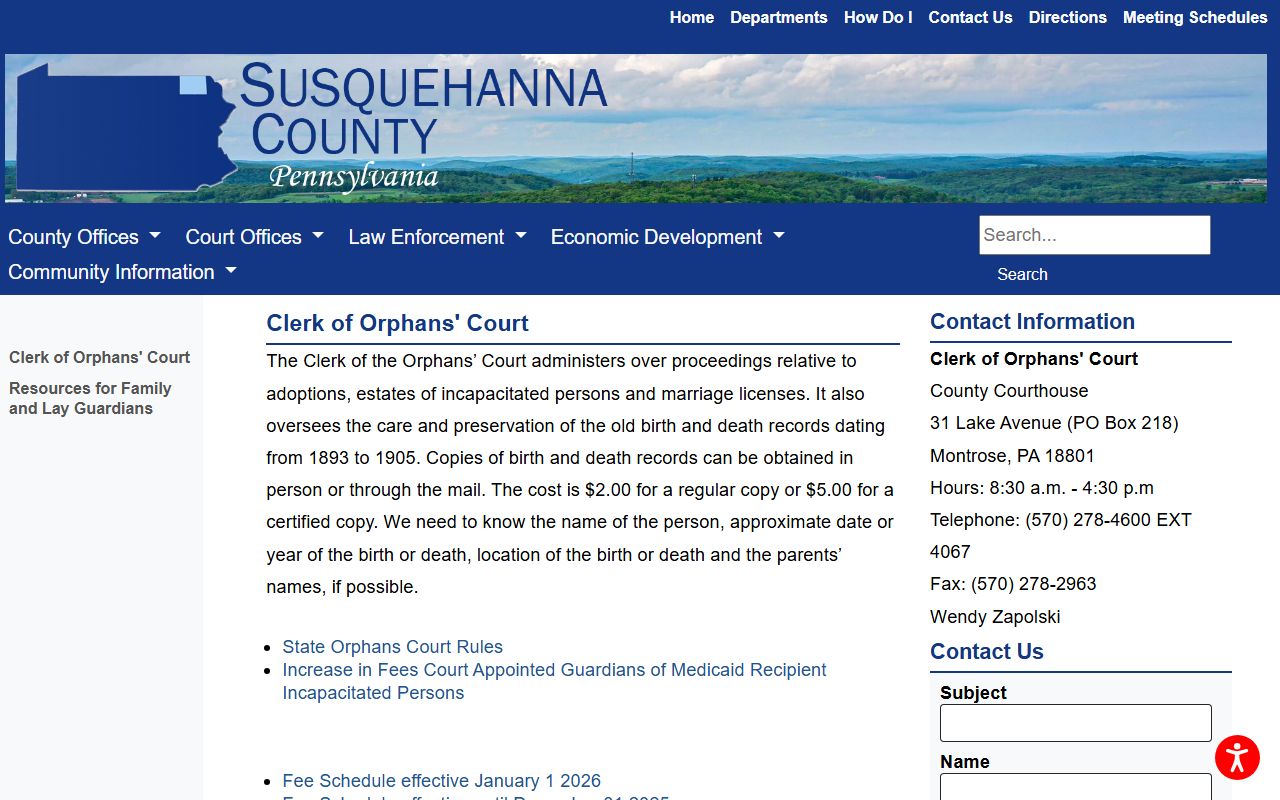
That office is the better starting point when a probate-related request involves adoption, guardianship, or a minor or incapacitated person.
Estate-copy requests should identify the decedent rather than only a surviving relative. Useful details include the decedent's full name, date of death, approximate filing year, whether a will existed, and the document needed, such as letters, inventory, inheritance-tax filing, or a certified copy of a will. If the request involves a guardianship or adoption, avoid assuming public access. The Clerk of Orphans' Court can explain whether the record is public, restricted, sealed, or available only by court order.
Probate records can also overlap with other county record offices. Real estate may connect to Register and Recorder land records, a civil dispute may create a Prothonotary file, and a contested estate issue may produce Orphans' Court docket activity. Start with the Register of Wills for estate administration, then follow the office's direction if the record is actually a deed, civil judgment, guardianship, or sealed adoption matter.
The payment rules are strict enough to affect access. If a requester wants stamped copies or receipts by mail, a self-addressed stamped envelope should be included. If it is omitted, the county applies the stated postage charge by page count. Exact payment is also important because the office rejects larger overages and keeps small overages as a convenience fee. Calling first helps avoid a rejected filing or delayed copy request.
Inheritance tax also has its own payment rule. The Register of Wills can accept some filing fees by credit card, but inheritance tax is cash or check only, payable to "Register of Wills, Agent." A probate appointment should therefore include a fee estimate and payment plan before the visit, especially when the estate value is uncertain or real estate is involved.
Historical record boundaries matter too. The Clerk of Orphans' Court keeps old county birth and death records from 1893 through 1905. After 1905, birth and death certificates are handled by Pennsylvania vital records, not by the probate counter. Marriage licenses are available locally from 1885 to present only when Susquehanna County issued the license. Those date ranges can save a request from being sent to the wrong custodian.
When a probate search is for family history, ask for the least restricted public record first, such as an estate index entry, will copy, or letters. When it is for legal use, ask whether the copy must be certified or exemplified. The office's rejection rule for disturbed certified records from another county shows how much form matters in estate filings.
Probate users should also separate estate value from asset title. The Register of Wills may need date-of-death values to estimate probate fees, but deed history, mortgage history, and land-record images are Register and Recorder matters. If an estate includes real property, both offices may be relevant, yet the will or estate file and the deed record remain separate records with separate copy rules and indexes. Ask which office owns the document before paying a fee or mailing a request. That is especially useful when an estate file and land record share the same family name locally.
Note: Historical birth and death records held locally cover 1893 through 1905; later state certificates use Pennsylvania vital records channels.